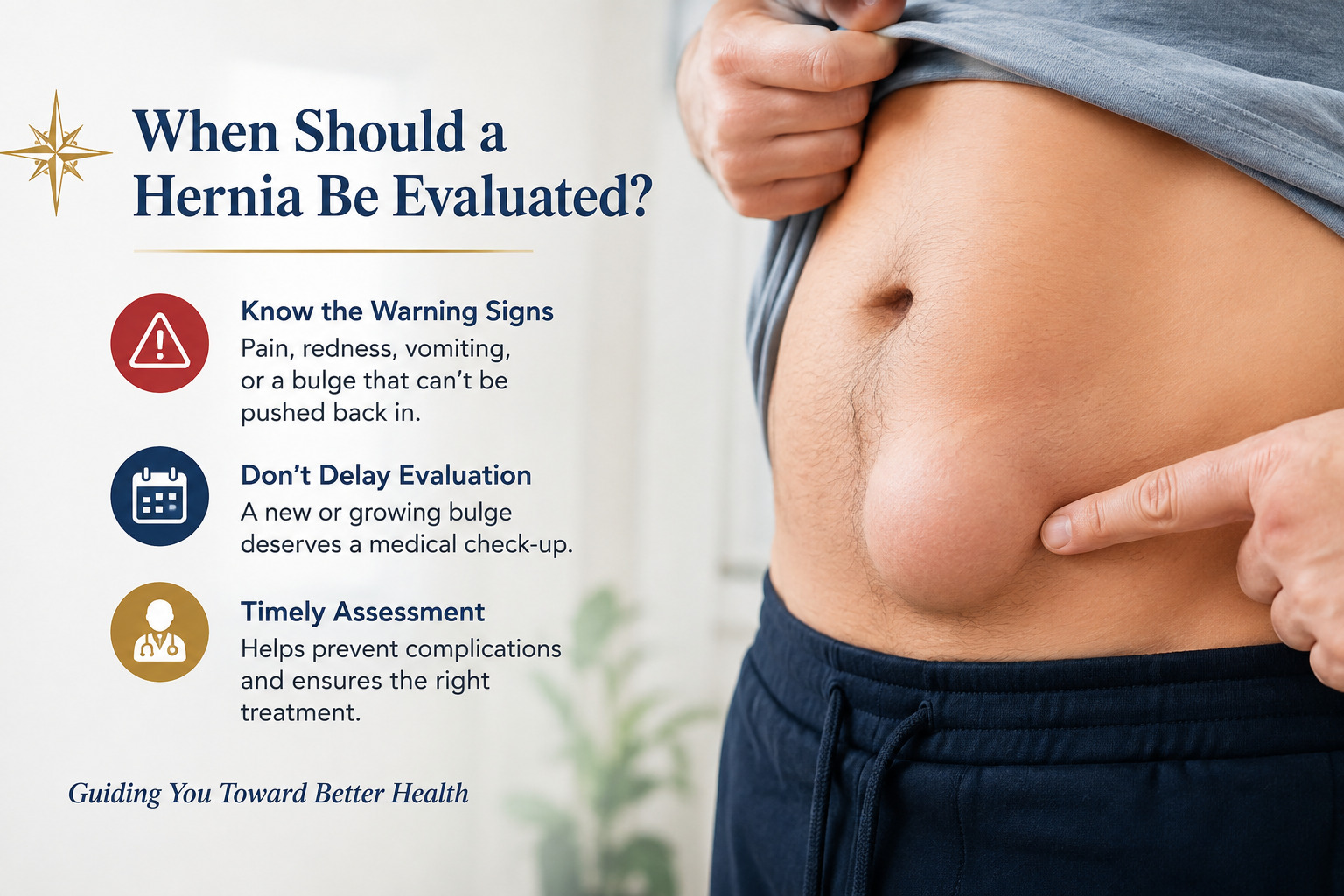
A hernia occurs when internal tissue, usually part of the intestine or fatty tissue, pushes through a weak spot in the surrounding muscle wall. A hernia may be painless at first, but a new, persistent, or enlarging bulge should be evaluated by a medical professional.
🚨 Seek Immediate Emergency Care
Seek emergency medical attention if you develop symptoms suggesting that the hernia has become incarcerated or strangulated—that is, trapped or at risk of losing its blood supply.
- Sudden, severe, or rapidly worsening pain at the site of the hernia.
- A bulge that changes colour and becomes red, purple, bluish, or dark.
- Nausea or vomiting, particularly when associated with increasing abdominal discomfort or distension.
- Inability to pass stool or gas.
- A hard, tense, or extremely tender bulge that can no longer be gently pushed back in.
📅 Schedule a Routine Doctor Visit
Arrange a non-urgent medical evaluation if:
- You notice a visible bulge in the groin, around the navel, or along an old surgical scar.
- You experience a dull ache, dragging sensation, or feeling of heaviness, particularly when standing, coughing, straining, or lifting.
- The bulge is gradually increasing in size.
- The hernia is becoming increasingly uncomfortable or is interfering with your daily activities.
Key Takeaway for Patients: Hernias generally do not heal on their own. Even when a hernia causes little or no pain and can be pushed back in when lying down, medical evaluation is advisable. Your surgeon can assess the type and size of the hernia, discuss the risk of complications, and determine whether observation or planned repair is appropriate.
If you have a painful, irreducible, or suddenly changing hernia, do not delay seeking medical attention.