When you learn that you or someone you love needs surgery, one of the first questions that may come to mind is: "Will I need open surgery, or can it be done through small incisions?"
Modern surgery offers several approaches. Depending on the condition and the individual patient, an operation may be performed through a traditional open incision or through minimally invasive techniques such as laparoscopic or robotic-assisted surgery.
The smallest incision is not always the best operation. The right surgical approach is the one that provides the safest and most effective treatment for your particular condition.
Understanding the Two Approaches
Open Surgery
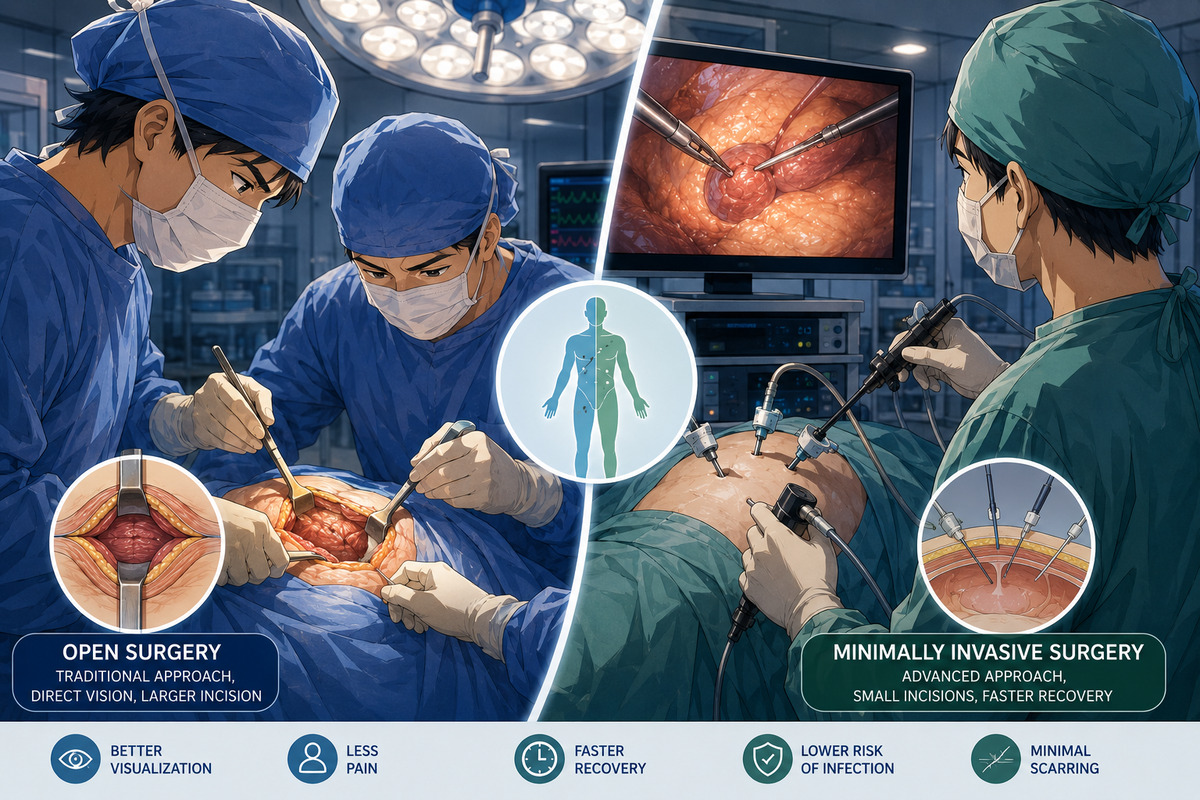
Open surgery is the traditional approach in which the surgeon makes a single incision of an appropriate size to directly access the organs or tissues that need treatment. It remains an important and highly effective part of modern surgery and is often the preferred approach in complex situations.
Minimally Invasive Surgery
Minimally invasive surgery allows the surgeon to perform an operation through relatively small incisions rather than one larger incision. It includes laparoscopic surgery and, in selected situations, robotic-assisted surgery.
Laparoscopic Surgery
In laparoscopic surgery, a small camera called a laparoscope and specialized instruments are introduced through small ports. The surgeon performs the procedure while viewing a magnified image of the operative field on a high-definition monitor.
Robotic-Assisted Surgery
In robotic-assisted surgery, the surgeon controls specialized instruments from a console. The system can provide high-definition three-dimensional visualization and enhanced instrument movement. Importantly, the surgeon remains in control of the procedure.
How Do They Compare?
Both approaches can achieve the same fundamental surgical objective. However, the experience of surgery and recovery may differ depending on the operation, the patient's health, and the surgical approach used.
| Feature | Open Surgery | Minimally Invasive Surgery |
|---|---|---|
| Incisions | Usually one larger incision, depending on the operation. | Usually several smaller incisions or ports. |
| Pain after surgery | There may be more wound-related pain because of the larger incision. | Often associated with less wound-related discomfort, although this varies with the procedure. |
| Hospital stay | May require a longer stay depending on the operation and recovery. | Some procedures can be performed as day-care surgery or with a short hospital stay. |
| Recovery | Recovery may be longer for some operations because of the larger incision. | Many patients may return to normal activities sooner, depending on the procedure. |
| Scarring | Usually one larger surgical scar. | Usually several smaller scars that generally become less noticeable with time. |
Is Minimally Invasive Surgery Always Better?
No.
This is one of the most important things for patients to understand. Minimally invasive surgery can offer important advantages, but it is not automatically the best choice for every patient or every operation.
The appropriate approach depends on several factors, including:
- The condition being treated and the complexity of the operation.
- Your anatomy and the location and extent of the disease.
- Previous operations and the presence of internal scar tissue or adhesions.
- Your general health and other medical conditions.
- The surgeon's experience with the proposed technique.
- The facilities and equipment available for the procedure.
- Your own preferences and priorities after understanding the benefits and risks.
When Might Open Surgery Be the Better Choice?
There are situations in which open surgery may provide the safest or most effective treatment. These can include:
- Complex scar tissue or adhesions: Previous abdominal operations may result in significant internal adhesions that can make minimally invasive access difficult or hazardous.
- Emergency situations: Severe infection, major bleeding, bowel compromise, or other emergencies may require rapid and direct surgical access.
- Large or complex conditions: Some large tumours, extensive hernias, or complex reconstructive procedures may be better managed through an open approach.
- Certain heart or lung conditions: Laparoscopic abdominal surgery involves insufflation of the abdomen with carbon dioxide. In some patients with significant cardiopulmonary disease, this may influence the choice of approach.
- Unexpected findings during surgery: Occasionally, an operation planned as minimally invasive may need to be converted to an open procedure because doing so is safer for the patient.
What Does "Conversion to Open Surgery" Mean?
Sometimes a surgeon begins an operation using a minimally invasive technique but decides during the procedure that an open approach would be safer. This is called conversion to open surgery.
Conversion may be necessary because of unexpected bleeding, difficult anatomy, dense adhesions, extensive disease, or difficulty safely completing the planned procedure through small incisions.
Conversion is not necessarily a complication. When it is required, it is often a deliberate safety decision made by the surgical team to achieve the best possible outcome.
Questions to Ask Your Surgeon
An informed decision begins with a good conversation. Before your operation, consider asking:
- Am I a suitable candidate for minimally invasive surgery?
- Why do you recommend this particular approach for me?
- What are the benefits and risks of open versus minimally invasive surgery in my case?
- What should I expect in terms of hospital stay and recovery?
- How much time might I need away from work or normal activities?
- If minimally invasive surgery is planned, could it need to be converted to an open operation?
The Bottom Line
Minimally invasive surgery has transformed modern surgical care. For appropriately selected patients, it can provide smaller incisions, less wound-related discomfort, shorter hospital stays, and an earlier return to normal activities.
But modern surgery is not about choosing the newest or smallest-incision technique simply because it sounds better. It is about choosing the right operation for the right patient.
Open surgery remains an essential, reliable, and sometimes preferable approach. In other situations, laparoscopic or robotic-assisted surgery may offer important advantages.
Your operation should be tailored to you.
The goal is always the safest procedure that provides the best long-term outcome for your health.
Talk openly with your surgeon, understand the available options, ask about the benefits and risks, and take an active role in the decision about your care.
Good surgery begins with good decisions—and good decisions begin with understanding.